
For a long time I thought of transaction data cleanup as a backend problem, the kind of issue you fix so a dashboard looks less messy and so you can add it to tech debt. But that changed entirely after I realised a mislabeled bank transaction is much more than a formatting nuisance. It can actually make the difference between a small business owner being approved for a loan and being declined for a reason nobody can explain.
The line item that started the discovery
I work on AI driven credit decisioning for a lending platform that reads connected bank account data to assess whether a small business qualifies for financing. That means our product stands between a mom and pop shop and their loan approval. Most of that assessment depends on mechanisms correctly understanding a single line of text on a bank statement, which is the transaction description.
For example, the same equipment financing company might show up as EQPFIN LLC in one statement and EQUIPMENT FINANCE CORP in another. A shipping vendor might be FDX in one bank's feed and FEDERAL EXPRESS in the next. A payment platform's name might show up instead of the actual vendor being paid, so a plumber gets logged as SQUARE INC or SQ*. These are the ordinary texture of a bank statement, and every one of them is a chance for a model to guess wrong about who got paid and why.
Why regular expression (regex) could never really solve this
Most systems use regex pattern matching, which are hand written rules that fire when a string contains an exact keyword. It is a reasonable first pass and the reason our problem never actually got solved. Every new merchant and new mom and pop bakery naming convention breaks a rule, ranging anywhere from Jerry’s Cakes to SBUX for Starbucks.
For example, we had a rule tuned specifically to catch FEDERAL EXPRESS. It worked reliably for months, until one bank's feed started sending the same vendor through as FDX 004421 GRAND RPD MI. The rule was built around a keyword that suddenly no longer applied, so the transaction fell through unclassified, pulling that business's expense picture out of shape.
When a description gets truncated, the keyword and the rule that depends on it both disappear together. Someone on the team then has to notice the miss and write a new rule by hand to catch it. That manual patching is why coverage always lagged behind reality, and why the fix only existed after a real customer had already fallen through the gap.
We measured how often the system's confidence in its own categorisation was too low to trust, and the low confidence scores showed up at a similar rate everywhere across retail spend, payroll, utilities, and transport alike.

A grocery purchase confused the system about as often as a payroll deposit did, or a utility bill, or a delivery charge, and those four things do not have much in common at all. What they did share was simpler than I expected: they were all being read by the exact same rulebook.
That is the moment it clicked for me that this was not a problem with a few strange merchant names here and there. The rulebook itself was the root cause
The data spoke for itself
The fix was a system that could actually interpret the text instead of just searching it. I led the move to an ensemble that paired a large language model with a sentence embedding model.
The language model layer took a raw, often mangled transaction string and enriched it with context, roughly reconstructing what a human underwriter would infer from a shorthand description. The embedding layer then compared that enriched text to known categories by meaning instead of exact spelling, so EQPFIN and Equipment Finance Corp could resolve to the same entity even though they barely share a character.
In a blind test, manual underwriters preferred the new model's description identification over the legacy output in more than half of the cases when the two disagreed. That is a meaningful swing in a business where the entire point is getting the read right often enough that a person does not need to double check it.
What I would tell any team still patching expression rules
Here is my advice to any risk team still treating this as a formatting problem. The cost of getting an entity wrong may not show up on your dashboard, but it still impacts real lives. A customer should not lose access to funds because her bank happens to abbreviate her vendor's name differently than her competitor's bank does.
Every rule you write to patch today's data format is a rule that could stop working the next time a payment processor changes its naming convention, and the customer affected by that failure will never know it was a text parsing problem and not a real reflection of their finances.
Where this shows up again, in a different department
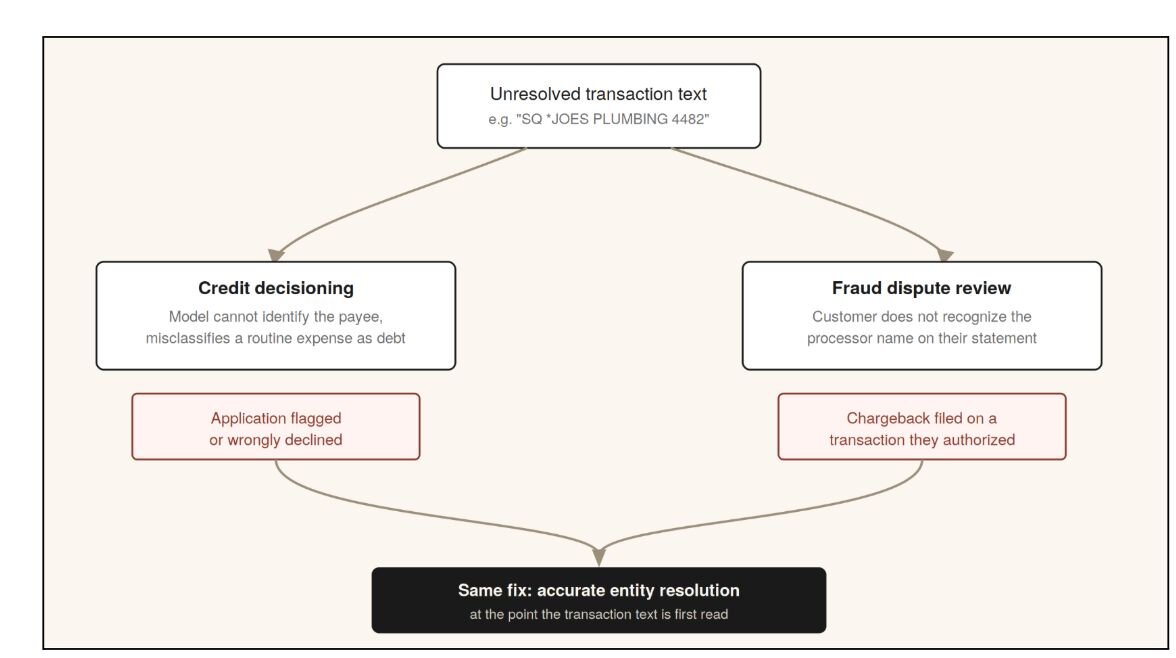
The same unresolved merchant name causes a different kind of problem on the fraud side. A customer looks at their statement, sees an unfamiliar string, maybe a payment processor's name instead of the local shop they actually visited, and files a dispute for a transaction they genuinely do not recognize.
This is not the customer trying to get away with anything. It falls into a category card issuers call friendly fraud, where the purchase was completely legitimate but the statement made it look fraudulent because the payment processor's name appeared unfamiliar.
Credit decisioning and fraud dispute review sit in two different departments, run by two different teams, tracked against two completely different metrics. But both teams are being tripped up by the same unresolved piece of text. Solve it once, right where the transaction description first gets read, and you are helping two departments who were, without realising, fighting the same fire.
